D.D. Jackson

Press Kits/Press Releases

← Back to Press Kits/Press Releases

Greenhouse Creators Consortium Presents an Innovative Festival at Soapbox Gallery, Brooklyn, Sept. 18–19

For Immediate Release:

On Friday and Saturday, September 18th and 19th, the Greenhouse Creators Consortium will present an innovative festival at Soapbox Gallery, 636 Dean Street, Brooklyn, in association with One Breath Rising (OBR), the Festival of New Trumpet Music (FONT), and Continuum Culture and Arts, Inc., which will feature workshops on September 13th, 15th, and 18th, as well as performances on September 18th and 19th.

The Greenhouse Creators’ Consortium (GCC) is comprised of six 501(c)(3) organizations focused on developing projects through organic collective action, with the goal of raising the awareness of artists and audiences. The six entities operate individually under the direction of a diverse and accomplished group of artists, all deeply focused on the art of improvised music and embracing a variety of disciplines in arts and education.

The Greenhouse Creators’ Consortium (GCC):
Glow Works — Iqua and Adegoke Steve Colson
Open Fortress — Monique Ngozi Nri and Ahmed Abdullah
Open-Minded Visions — Elizabeth and D.D. Jackson
Sound System Culture — Martha Cinader and Jay Rodriguez
Sonic Blue Arts and Education — Michael Wimberly
Primal Voice — Melanie Scholtz

Workshops:
Art Workshop with Melanie Scholtz — Sunday, September 13th (GCC event), location and time TBA
Music Workshop with Ahmed Abdullah — Tuesday, September 15th, 2–3:30 pm at The New School (FONT event)
Poetry Workshop with Monique Ngozi Nri — Friday, September 18th (GCC event), location and time TBA

Performances:

Produced by OBR and Soapbox Gallery:
Friday, September 18th — Vanessa Rubin and Trio at Soapbox Gallery, 636 Dean Street, Brooklyn, 8 pm

Produced by GCC and Soapbox Gallery, 636 Dean Street — doors open at 6 pm:
Saturday, September 19th
7:00 pm — Ahmed Abdullah’s Diaspora with vocalist/poet Monique Ngozi Nri, saxophonist Don Chapman, pianist Alexis Marcello, bassist Norbert Marius, and multi-percussionist George Gray, with the leader Ahmed Abdullah on trumpet, flugelhorn, and vocals
7:50 pm — D.D. Jackson with saxophonist Jay Rodriguez, bassist Norbert Marius, and multi-percussionist Michael Wimberly, with the leader on piano
8:20 pm — Martha Cinader, poetry, with saxophonist Jay Rodriguez
9:10 pm — Jay Rodriguez’s composition for the GCC featuring all the members!
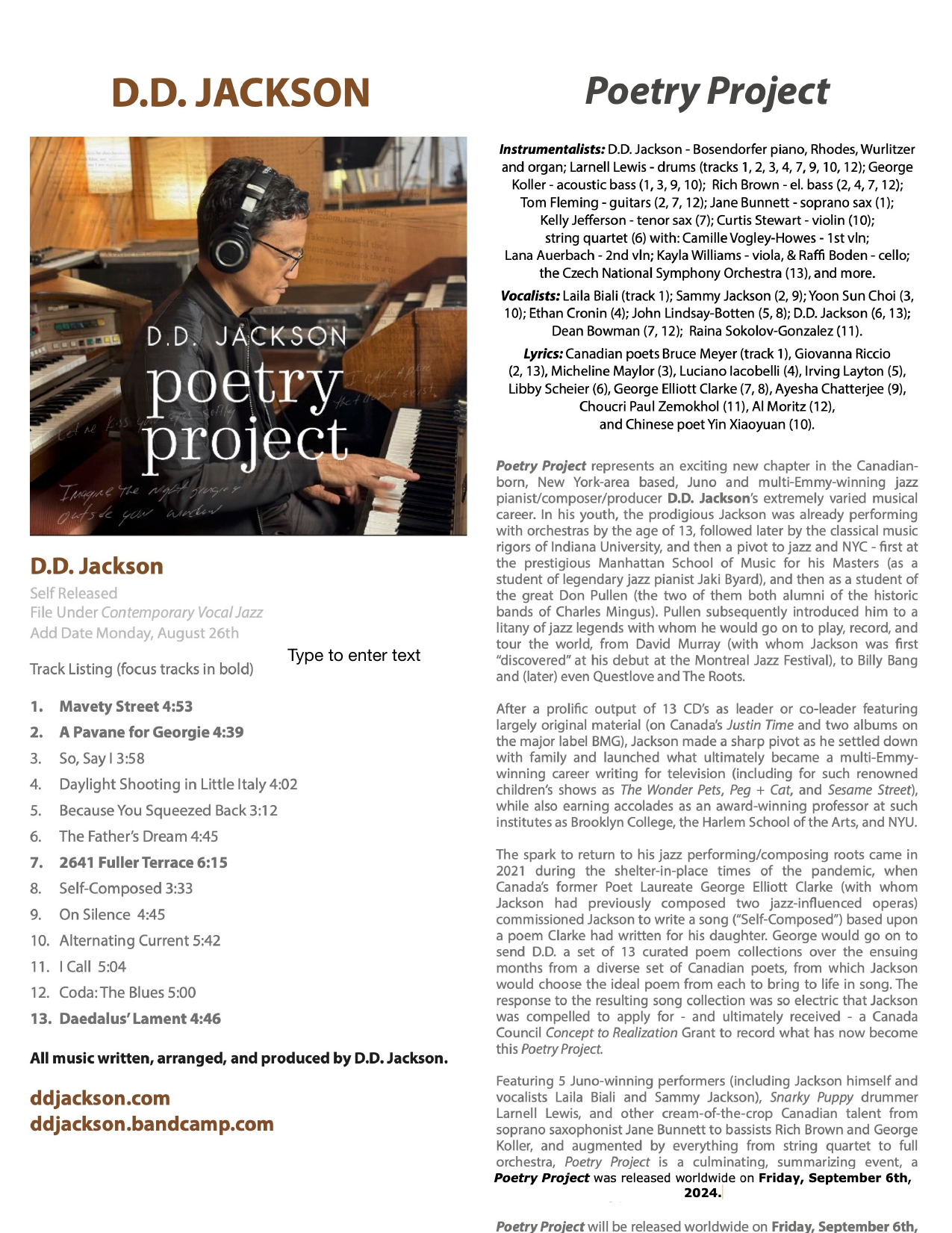
D.D. Jackson: Poetry Project — One Sheet

D.D. Jackson: Poetry Project one-sheet

Download the one-sheet (PDF) →

Jazz Convergence: D.D. Jackson & Mentor David Murray at Blues Alley, Nov 7–8

Emmy-Winning Pianist/Composer D.D. Jackson’s Highly Anticipated Reunion with Tenor Sax Legend for Two Nights Only at Historic D.C. Club

[Nov 1/23, for immediate release]: D.D. Jackson is excited to be re-uniting with his longtime mentor and colleague David Murray for two nights only at Washington D.C.’s historic jazz venue Blues Alley.

Night 1 (on Tues. Nov. 7th) will feature both Jackson and David Murray sitting in as special guests of D.C. staple violinist Dave Kline, for which several Jackson compositions will be featured with Murray.

Night 2 (on Wed. Nov. 8th) shifts to Jackson leading his own band composed of D.C. luminaries Eric Kennedy on drums and Obasi Akoto on bass, with Murray once again taking center stage and featuring a rich cross-section of Jackson’s compositions.

“Working with David has been one of the most formative experiences of my life,” Jackson reflects. “After my mentor Don Pullen first introduced us, David helped launch my career when he had me sub for John Hicks at the Montreal Jazz Festival, leading to my signing with Justin Time Records.” Jackson’s first album yielded the title tune “Peace-Song”, which he would go on to perform with Murray all over the world and which he plans to re-visit in D.C. on Night 2, along with many more.

Since their past work together, Murray has continued with his breakneck recording career and touring schedule. Jackson meanwhile found himself settling down and eventually went on to win Emmy Awards writing for television, including children’s shows like The Wonder Pets and Peg+Cat (with his kids becoming his new “fans”!), doing collaborations with The Roots, and becoming increasingly involved in education (including at Jay-Z’s new Roc Nation school at LIU Brooklyn).

The pianist of late, however, has picked up the jazz mantle once more, including a large-scale album project slated for a Spring/24 release entitled “Poetry Project” featuring 8 singers, and instrumentation ranging from symphony orchestra and string quartet to a rhythm section featuring Snarky Puppy drummer Larnell Lewis. Jackson himself also sings on two tracks, and plans to do the same for his Nov. 8th Blues Alley leader date. “I don’t consider myself a singer by trade, but the two songs I plan to premiere were so close to my heart that I couldn’t resist!” he remarked.

It should be a two-night Blues Alley residency — and musical reunion — not to be missed.

D.D. Jackson Releases First Jazz CD as Leader in Over 12 Years

[Aug. 15/19, for immediate release]: Canadian-born, New York area-based D.D. Jackson’s new CD Live at Freedom of Sound captures a recent solo piano performance that took place at the Montclair-based festival organized by drummer Pheeroan Aklaff’s Seed Artists. “I had actually just gotten off a plane from L.A. after winning an Emmy Award the night before and was definitely tired. However, something that evening just clicked, and the performance became an enjoyable and surprisingly effective representation of where my solo piano playing is today!”

That journey has taken him from a career that’s included 12 CD’s as leader or co-leader (including two for the major label BMG), performing all over the world with prominent artists ranging from David Murray, Jack DeJohnette, and Billy Bang, to MacArthur Genius Grant drummer Dafnis Prieto and James Carter. But why the long gap since his last jazz recording as leader?

“The making of my last CD (Serenity Song, 2007 Justin Time Records) was right around the time I began settling down and raising a family, and it was appealing to finally be in one place for extended periods of time instead of constantly on the road touring,” Jackson states. “At the same time, I was also gaining an increasing fascination with technology and began writing more and more for media, which was a perfect gig for a homeward-bound dad!”

Jackson’s work, in fact, culminated in his 2nd Emmy Award as a television composer just this past May (among his 5 total Emmy nominations to date), and he also struck up a regular working relationship with New York-based The Roots on various projects (and appeared on two of their most recent CD’s, participating as arranger, pianist, and producer on different tracks). Jackson has also been passionate about teaching during this period, first as an award-winning professor at Hunter College; at the Harlem School of the Arts (where he taught jazz prodigy Matthew Whitaker and the “The Voice” finalist We’ McDonald, among many); and now at Brooklyn College, where he’s been helping with their new Global Jazz Masters degree and also teaching Media Scoring.

All the while, though, Jackson continued playing and performing. “It’s always been in the back of my mind to do a new CD,” he muses, “and frankly, Trump’s shocking ascendancy finally gave me just the emotional ‘breaking point’ I needed to dive in musically, initially just as a means of ‘venting’!”

Live at Freedom of Sound is a tight set of 5 compositions, ranging from re-imaginings of older material (including “For Don” — originally written by Jackson in tribute to his late mentor, the jazz pianist/composer Don Pullen, now re-dedicated to another great influence on Jackson, the late baritone saxophonist Hamiet Bluiett; and “Richard’s Tune” — a Don Pullen composition Don originally wrote for Muhal Richard Abrams), to brand new pieces that serve as a reaction to Trump (“Better Angels”, “Homecoming” — a meditation on his hometown of Ottawa and Canada in general during these stressful times, and the more up-tempo “D.D.’s Bounce”, which Jackson states is intended to provide an “upbeat sort of catharsis”).

Jackson says there are more pieces in the pipeline, and more recording plans to come.

D.D. Jackson and James Brandon Lewis Duo Concert at Zürcher Gallery (NYC)

[Jan. 18/18, for immediate release]: On Tues., Feb. 13th at 8 pm, Emmy-winning jazz pianist/composer D.D. Jackson will be joined by critically-acclaimed tenor saxophonist/composer James Brandon Lewis for a special, one-night-only duo concert, featuring originals culled from both of their books, plus at-the-moment improvisations. The concert will take place at the Zürcher Gallery located at 33 Bleecker St., New York, NY — an intimate art gallery space that has built an increasing reputation for its relaxed, inviting setting and the open-minded, no-holds-barred attitude of its performers.

The concert will represent a continued return for Jackson to jazz performance and to the writing and premiering of original jazz compositions, following a detour the past several years as he delved more into the world of composing for television and film (culminating in his 4 Emmy nominations, and his first Emmy Award win as composer in 2016).

As Jackson states: “After settling down and raising our two kids, I found myself wanting to be more in one place and to challenge myself in new creative directions, and writing for t.v. and media has filled the role perfectly for the past several years, even as I continued to occasionally perform jazz. However, I was ‘jarred’ out of my jazz complacency by the confluence of a few notable events. First, I began playing out again increasingly, including with tenor saxophonist David Murray at the Village Vanguard this past May, and prior to this with James Brandon Lewis for the first time in a group led by the great baritone sax player Hamiet Bluiett. James’ fiery energy, his inventiveness as composer, and his ability to incorporate contemporary rhythms while still maintaining a passionate ‘edge’ — all of this really inspired me to want to find a way to work with him at the earliest opportunity!”

“The other (odd!) source of inspiration was definitely the frustrating ascendancy of Donald Trump, which has renewed in me a desire to ‘vent’ and to more than ever truly express myself creatively, resulting in a string of new jazz compositions, several of which will be given their NYC premiere at the performance, along with James’ own pieces. I’m really looking forward to it!”

D.D. Jackson to Give First Public Jazz Performances in His Ottawa Hometown After Almost 10 Years

Juno and Emmy Award-Winning D.D. Jackson to Give First Public Jazz Performances in His Ottawa Hometown After Almost 10 Years, with Special Appearance by John Geggie

[May 8/17, for immediate release]: On May 18 and 19, 2017, New York-based, Juno and Emmy award-winning jazz pianist/composer D.D. Jackson will return to perform in his hometown of Ottawa for the first time in almost 10 years, joined in part by bassist John Geggie (formerly of the popular “Geggie Concert Series” of NAC Fourth Stage).

First, on Thursday May 18th at 7:30 pm, Jackson will be the special guest of the Highlights Concert of the Ottawa Kiwanis Music Festival, performing solo piano.

When asked to participate, Jackson leapt at the chance. “I have so many fond memories of playing in the Festival (back when it was called the ‘Ottawa Music Festival’!), and can legitimately say that it’s truly where I first got my start as a performer, from an extremely young age into high school. It’s satisfying to see the Festival continue to thrive, and I’ll be excited to premiere some new material I’ve been working on lately in anticipation of recording a new jazz album soon!”

Then, after a masterclass at Canterbury High School the morning of Friday, May 19th (closed to the public), Jackson is excited to perform with his former bandmate and Ottawa jazz bassist John Geggie, in a special, intimate concert at the 45-seat “GigSpace”, featuring solo piano originals, as well as some duos with Geggie as his special guest.

The performances will mark a return for Jackson to the writing and premiering of original jazz compositions, following a detour the past several years as he delved more into the world of composing for television and film (culminating in his 4th Emmy nomination last month, and his first win last year, for the 7 Emmy-award-winning PBS show Peg+Cat).

“After settling down and raising our two kids, I found myself wanting to be more in one place and to challenge myself in new creative directions, and writing for t.v. and media has filled the role perfectly for the past several years, even as I continued to occasionally perform jazz. Two events, however, have really combined to rekindle in me a passionate desire to express myself again more fully in the jazz sphere. The first was the return to New York of the great tenor saxophonist David Murray, with whom I just completed a successful week at the Village Vanguard. The second (oddly!) is the frustrating ascendancy of Donald Trump, which has renewed in me a desire to ‘vent’ and to more than ever truly express myself creatively, resulting in a string of new jazz compositions, many of which I plan to premiere at the two performances!”

Multi-Emmy-Winning D.D. Jackson Describes the Process Behind His New “Virtual Ensemble” Service

“Remotely Recorded Ensembles” allows choral, instrumental, and musical theatre groups to perform “together” — even while sheltering-in-place in this COVID age.

MAPLEWOOD, NJ, June 17, 2020 — When all on-campus classes of the Brooklyn College Big Band were cancelled, the band’s Director, D.D. Jackson, a Canadian-born, greater New York City-based resident and multi-Emmy-winning composer, told his students to play together anyway, virtually. Jackson proceeded to create guide tracks, which the students subsequently listened to on headphones while they used their phone cameras/mics to simultaneously record their own individual parts when they had a moment to do so. He then mixed their resulting audio, and edited their videos together, trying to best match the ebb and flow of the music. The reaction to the results was overwhelmingly positive, encouraging Jackson to start his new service, Remotely Recorded Ensembles.

Recently we sat down with D.D. to learn more about the process:

What’s the biggest misconception that people have about the service?

I’m realizing that people see the videos and often think they must have been recorded “live” over Zoom (with some further video tweaking perhaps after the fact). So I realize I need to do a better job of explaining the process, which is really much more involved in order to recreate the feeling of “live” even as we shelter-in-place.

Describe that process?

It really starts with a guide track that everyone can record to. For a recent Middle School’s vocal project (for example), I had the Music Director record herself singing all 4 sections to the same piano accompaniment I provided, and then sent this out to the 24 singers, who subsequently listened to it on headphones while they used their phone’s video camera and mic to record themselves singing just their individual parts. I then took the audio from all the videos and imported them into Logic Pro (my audio editing program), applying noise reduction, optimizing the sound so they all sounded like they were in the same room, and moving things like “s” sounds around so they all lined up (something trickier to do when not actually recording together!) The final stereo audio mix was then imported into my video editing program (Final Cut Pro X) along with all the individual videos, where I worked on creating a video version that complemented the vibe of the music.

What sort of setup do the individual performers need? Do they need a professional microphone?

All they need is a typical phone camera/mic. I’ve worked with some university students who have better mic setups in which case they simply record video of them doing their part, and then send it along with the “better” audio for me to sync up. But — regardless of the source — I will work to equalize things/balance/compress the sound and then line things up to make everything feel plausibly in the same room, just as I would with any recording I’ve produced in the past.

What is the maximum number of parts you can accommodate?

The largest I’ve done thus far is 26 separate parts. However, the sky technically is the limit — it really depends upon the time/budget factor.

Does the ensemble director need to have all the arrangements written out, or can you help with this?

I always love helping with arrangements if asked (calling upon my background as a multi-Emmy winning composer for t.v., an arranger for The Roots, composer for big band, etc.). I’m working with a gospel group right now, for example, where the group’s leader has specifically requested that I put my own “spin” on the piece she wants to do, and has also requested that I play piano/keys.

Can the ensemble director still take part as conductor?

Yes, and there’s two ways I’ve been experimenting with this. One involves more “cosmetic” (after the fact) conducting, where I essentially create the backing track, give it to the conductor who uses it to record a video of them conducting to it; and then when I edit the final videos together of all the players I mix in the conducting (visually) as well. I’ve also had situations where it’s really important for the players to actually record their parts while watching the conducting (such as for pieces that have a lot of speeding up/slowing down and other interpretive touches). The whole process can seem complicated but the result, people have found, is well worth it and it feels good to preserve something for posterity, especially in this shelter-in-place age!

D.D. Jackson’s Virtual Ensemble Service Lets Groups Recapture Feeling of Playing Together

Remotely Recorded Ensembles allows choral, instrumental, and musical theatre groups to perform “together” — even while sheltering-in-place in this COVID age.

MAPLEWOOD, NJ, June 23, 2020 — When all on-campus classes of the Brooklyn College Big Band were cancelled, the band’s Director, D.D. Jackson, a greater New York City-area resident and multi-Emmy-winning composer, told his students to play together anyway, virtually. Jackson proceeded to create guide tracks, which the students subsequently listened to on headphones while they used their phone cameras/mics to simultaneously record their own individual parts when they had a moment to do so. He then mixed their resulting audio, and edited their videos together, trying to best match the ebb and flow of the music. The reaction to the results was overwhelmingly positive, encouraging Jackson to start his new service, Remotely Recorded Ensembles.

Recently we sat down with D.D. to learn more about the process:

What’s the biggest misconception that people have about the service?

I’m realizing that people see the videos and often think they must have been recorded “live” over Zoom (with some further video tweaking perhaps after the fact). So I realize I need to do a better job of explaining the process, which is really much more involved in order to recreate the feeling of “live” even as we shelter-in-place.

Describe that process?

It really starts with a guide track that everyone can record to. For a recent Middle School’s vocal project (for example), I had the Music Director record herself singing all 4 sections to the same piano accompaniment I provided, and then sent this out to the 24 singers, who subsequently listened to it on headphones while they used their phone’s video camera and mic to record themselves singing just their individual parts. I then took the audio from all the videos and imported them into Logic Pro (my audio editing program), applying noise reduction, optimizing the sound so they all sounded like they were in the same room, and moving things like “s” sounds around so they all lined up (something trickier to do when not actually recording together!) The final stereo audio mix was then imported into my video editing program (Final Cut Pro X) along with all the individual videos, where I worked on creating a video version that complemented the vibe of the music.

What sort of setup do the individual performers need? Do they need a professional microphone?

All they need is a typical phone camera/mic. I’ve worked with some university students who have better mic setups in which case they simply record video of them doing their part, and then send it along with the “better” audio for me to sync up. But — regardless of the source — I will work to equalize things/balance/compress the sound and then line things up to make everything feel plausibly in the same room, just as I would with any recording I’ve produced in the past.

What is the maximum number of parts you can accommodate?

The largest I’ve done thus far is 26 separate parts. However, the sky technically is the limit — it really depends upon the time/budget factor.

Does the ensemble director need to have all the arrangements written out, or can you help with this?

I always love helping with arrangements if asked (calling upon my background as a multi-Emmy winning composer for t.v., an arranger for The Roots, composer for big band, etc.). I’m working with a gospel group right now, for example, where the group’s leader has specifically requested that I put my own “spin” on the piece she wants to do, and has also requested that I play piano/keys.

Can the ensemble director still take part as conductor?

Yes, and there’s two ways I’ve been experimenting with this. One involves more “cosmetic” (after the fact) conducting, where I essentially create the backing track, give it to the conductor who uses it to record a video of them conducting to it; and then when I edit the final videos together of all the players I mix in the conducting (visually) as well. I’ve also had situations where it’s really important for the players to actually record their parts while watching the conducting (such as for pieces that have a lot of speeding up/slowing down and other interpretive touches). The whole process can seem complicated but the result, people have found, is well worth it and it feels good to preserve something for posterity, especially in this shelter-in-place age!

Press release not found. Return to Press Kits/Press Releases

← Back to Press Kits/Press Releases